Wednesday, 11 May 2016

Cugles

Bach (I am sure that is not the correct pronunciation) near the top of our walk. Any viewers might notice that our postings are starting to mention words connected with sedate exercise (oxymoron). This is a vain attempt to negate the ever increasing effect of the French pastries.

As high as we got with Cugles near the horizon.

Some rocks.                                                           


Cugles is a small village where the main road runs through the centre, carrying a decent amount of traffic. It is notable for two things:
1. The pastry shop.
2. The speed and recklessness of the drivers that pass through. Perhaps, because of its proximity to the Citroen testing track or Monaco, the drivers all seem to think they are Alain Prost. We have been impressed with the standard of driving generally in Europe, but the south of France is a different kettle of fish. They overtake on blind corners (everybody overtakes us), ignore the speed limit and believe pedestrian crossings are an excuse to speed up. 

Maximim St Baume

Looking up at the Abbey from the track.

Mary's cave.

A view of the Abbey from the road.

We had company on the ridge.

Part way up.
The Apostle of Provence (Mary Magdalene), either under persecution from the Romans or because she felt the need for solitary contemplation, lived here for thirty years. A very peaceful and spiritual place.

Tuesday, 10 May 2016

Ansouis, Provence

Returning to the Luberon and the places we saw with Pip and Brian last year was great fun. Spring is so much more advanced than the rest of France we have been in. Completely different light and colours.
We have decided to include in our blog only one village, Ansouis. A hilltop village where the buildings are exceptionally well preserved.


Friday, 6 May 2016

Les Estables, elevation 1350m

Until we reached Les Estables our journey through France was only delayed by a puncture and the numerous boulangeries; that was until we encountered snow at Les Estables.
Snow in May is equivalent to snow in November in New Zealand.
Once the snow plough had gone through and we had extricated ourselves from the cafe, we traveled approximately 60 kilometres in which time the temperature increased from zero degrees to 23 degrees; a bit like returning from Arthur's Pass to Christchurch on a nor' west day. 
Tree hugger

It was at this point our wheels lost traction. We had practice at reversing about 2 kilometres.

Outside the cafe. The barman said, "What are you doing at the end of the world."

Nobody keen?

Christmas card look to the trees.

A bit chilly Tones?

Chateau Chambord

Built between 1519 and 1547 for King Francis I as a hunting lodge (440 rooms), the building incorporates a range of mathematical patterns. The form follows a square grid, but undoubtedly the highlight is the double helix staircase that may have been designed by Leonardo de Vinci. He lived close to the property and was a friend of the king.


Slits in the walls of the staircase enable you to have conversations with the person on the same height, but on the other stairway, of the double helix.
I spent almost the whole time we were in the chateau ascending and descending the stairway. Sad.

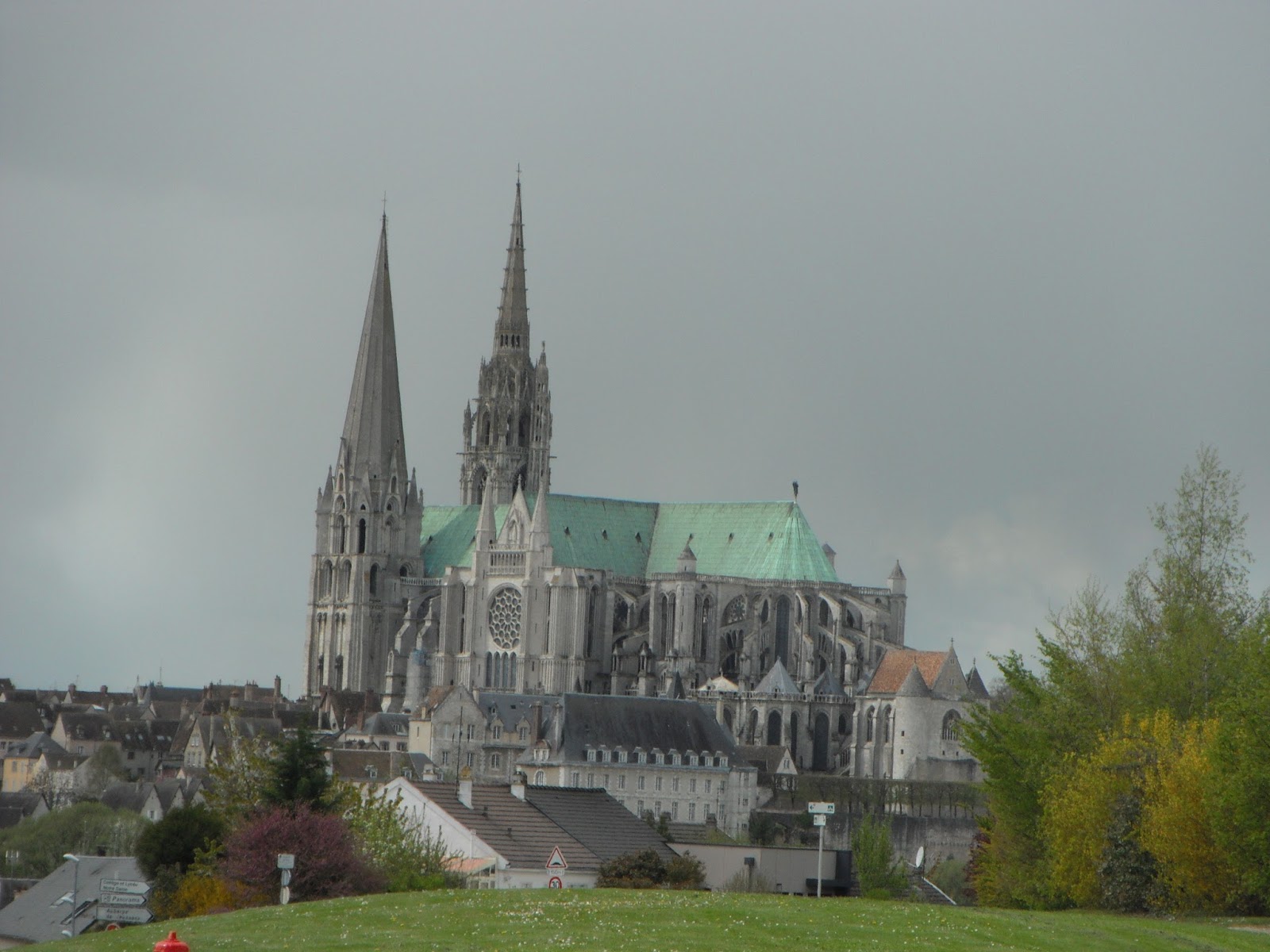
Chartres Cathedral


Chartres Cathedral, completed in 1160, contains numerous stained glass windows of exquisite beauty.

Wednesday, 4 May 2016

William (the Conqueror) and Matilda (de Flanders)

We have finished our Normandy D day explorations. The celebrations for the end of the war in Europe are due to take place on the 8th of May. This seems to be very important for France, their day of liberation (jour de la liberation) and the beginning of the fourth French Republic.

Unfortunately for anybody getting tired of our unhealthy fascination with war, we have not finished revisiting our military history. We have merely wound the clock back 1000 years to the time of William the Conqueror and his wife, Matilda. It was his Norman conquest of England in 1066 that lead to our ancestors being Norman (or at least a mix of Norman and Saxon), rather than Saxon.

The Abbey Aux Dames, Caen, Normandy: Matilda de Flanders tomb lies within.

Interior of the Abbey Aux Dames
William's burial site in Abbey aux Hommes, Caem, Normandy

The Abbey aux Hommes.


William the Conqueror resplendent in battle armour.
William's 10th Century castle in Falaise, Normandy